

Featured Aviation and Aerospace Projects









About Sprung Aircraft Hangars
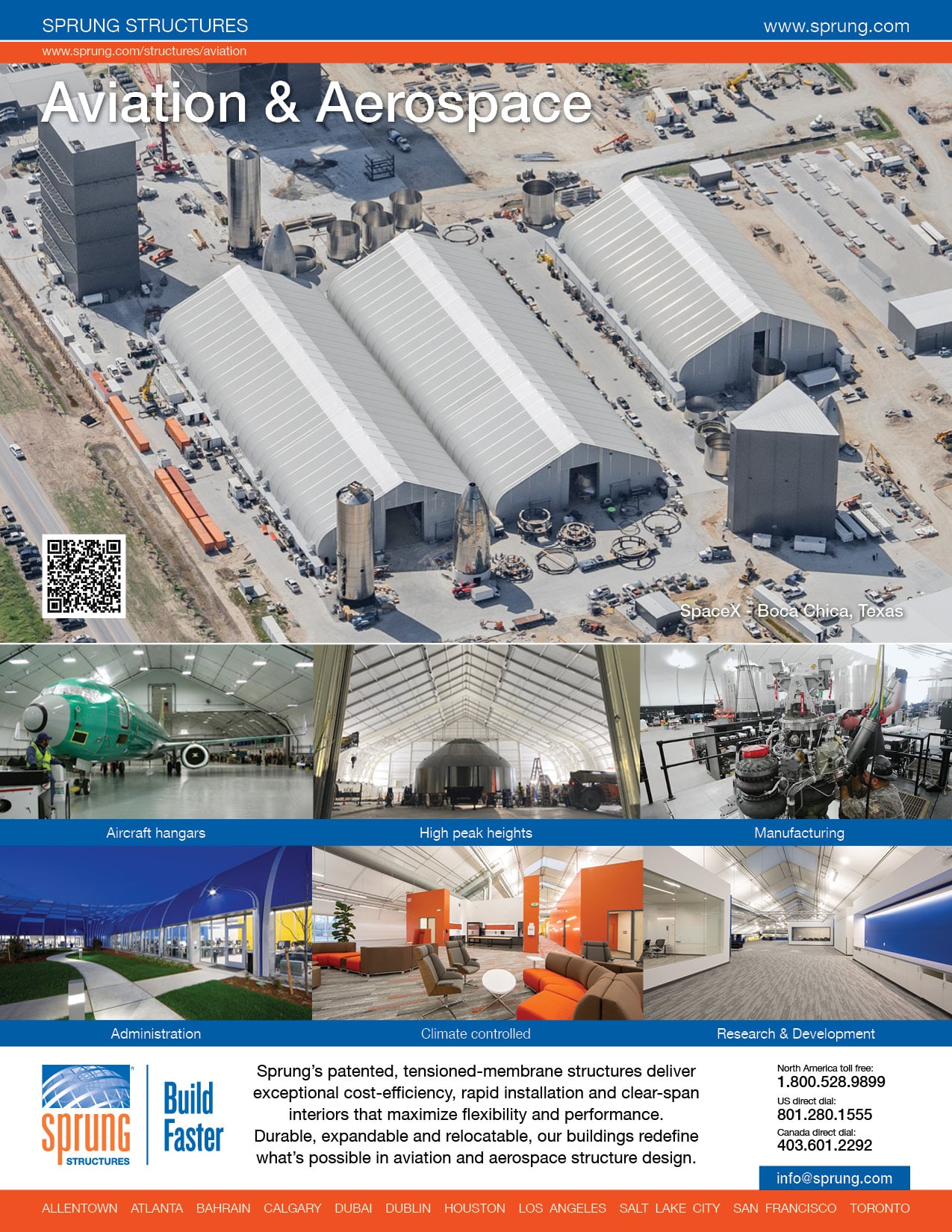
Sprung aircraft hangars provide enclosed, climate-controlled environments designed to protect aircraft and support daily aviation operations. These high-performing structures serve as permanent or temporary airplane hangar solutions across commercial, private and defense sectors. Rapidly deployable and adaptable, Sprung aviation hangars offer a cost-effective alternative to traditional aircraft hangar construction while delivering durable performance and faster overall project timelines.
Airplane Hangar Design
Sprung aircraft hangars use clear-span construction to create unobstructed bay space for aircraft movement, storage and maintenance. Large door openings and adaptable door systems accommodate a wide range of aircraft sizes and operational requirements. The absence of interior columns allows our airplane hangar layouts to be configured or adjusted without structural constraints.
Fabric Hangar Durability & Operational Efficiency
Sprung’s aviation hangars are designed to support daily aviation operations for a wide range of operators and aircraft types. The structural components of a Sprung airplane hangar or helicopter hangar are designed to withstand heavy everyday use and challenging environmental conditions while maintaining a stable interior environment. Virtually maintenance-free, Sprung’s large aircraft hangars are optimized for storage, maintenance and crew comfort.
Code Compliance & Expansion Readiness
Sprung’s aviation hangars are engineered to meet applicable aviation, building and regional code requirements, making them an ideal choice for aircraft hangar builders. The modular design of a Sprung structure allows our permanent and temporary hangars to be expanded, reconfigured or relocated as fleet size or operational needs change. This supports phased development and long-term flexibility of plane and helicopter hangars without committing to a fixed footprint.
FAQs About Sprung’s Aircraft Hangars
Are fabric buildings suitable for aircraft hangars?
Yes, fabric buildings are a suitable solution for both permanent and temporary aircraft hangars if they are designed to meet the proper aviation and building requirements. Sprung’s aviation hangars are engineered to protect aircraft from environmental exposure while maintaining stable interior conditions for maintenance and storage. Each fabric hangar by Sprung provides unobstructed interior space that accommodates aircraft movement, daily aviation operations, mechanical equipment and more.
How quickly can a clear-span airplane hangar be installed?
A clear-span airplane hangar using prefabricated systems can be installed significantly faster than conventional aviation hangars. Much of the fabrication occurs off-site, reducing on-site construction time. Additionally, the minimal foundation requirements for a Sprung airplane hangar or helicopter hangar contribute to the speed of installation. Sprung portable hangar and permanent hangar systems are typically erected in weeks rather than months. This allows aviation operations to become active sooner.
How does a fabric aircraft hangar compare to a steel hangar?
When compared to a steel hangar, a fabric aircraft hangar offers optimal performance while reducing construction time and foundation requirements. A Sprung airplane hangar uses a tensioned membrane over an aluminum structural framework to create a clear-span structure that requires less material weight and site preparation than conventional steel buildings. Sprung’s aircraft hangars are designed to meet aviation load and environmental standards while simplifying installation and future expansion. This makes fabric hangars a practical choice when speed, flexibility, and long-term durability are priorities.
Are modular hangars suitable for defense and aerospace operations?
Yes, modular aviation hangars are suitable for defense and aerospace operations because they combine durability with operational flexibility. The clear-span airplane hangar design supports aircraft storage, maintenance activities and mission-critical equipment without interior obstructions. Sprung’s aviation hangars are engineered to withstand demanding operational conditions while accommodating large doors, mechanical systems and evolving fleet requirements. This makes a Sprung aircraft hangar appropriate for both base infrastructure and mission-driven deployments.
How do fabric hangars handle large doors and clear openings?
Fabric hangars are specifically designed to accommodate the large door openings required for aircraft access and movement. Door systems—including telescoping, sliding and rolling options—can be easily integrated into the aircraft hangar framework. A Sprung airplane hangar or helicopter hangar features large, clear openings without interior obstructions, allowing aircraft to move efficiently in and out of the space. The large doors of Sprung’s fabric aircraft hangars supports a wide range of aviation operations.
How can fabric hangar layouts support mixed fleets and equipment?
Fabric hangar layouts support mixed fleets and equipment by using clear-span interiors that allow aircraft of different wingspans and tail heights to be positioned without structural constraints. This makes it easier to organize space for a variety of aircraft types within the same fabric aircraft hangar. Ground support equipment, maintenance zones and storage areas can also be arranged alongside aircraft without fixed structural constraints. Sprung’s permanent and temporary aircraft hangars provide the flexibility to adjust layouts as requirements evolve.
How do insulated fabric hangars protect aircraft and comfort crews?
When insulated, fabric hangars protect aircraft and crews by creating a controlled interior environment that limits temperature fluctuations and moisture exposure. Sprung’s performance insulation and virtually airtight membrane reduce heat loss and air infiltration, helping maintain stable conditions inside the airplane hangar. This protects aircraft components from condensation, corrosion and extreme temperatures while improving working conditions for personnel. Sprung’s aviation hangars are engineered to support consistent thermal performance in both hot and cold climates.
Can a modular aircraft hangar be relocated or expanded over time?
Yes, modular aviation hangars can be expanded, dismantled and reinstalled as operational needs evolve. A portable airplane hangar or helicopter hangar can be disassembled, transported and reconstructed at a new location using the original structural components. Sprung aircraft hangars are also designed to be lengthened or reconfigured to accommodate fleet growth or changing aviation requirements. This approach supports phased aviation development without committing infrastructure to a single long-term footprint.