












About Sprung’s Warehouse Buildings
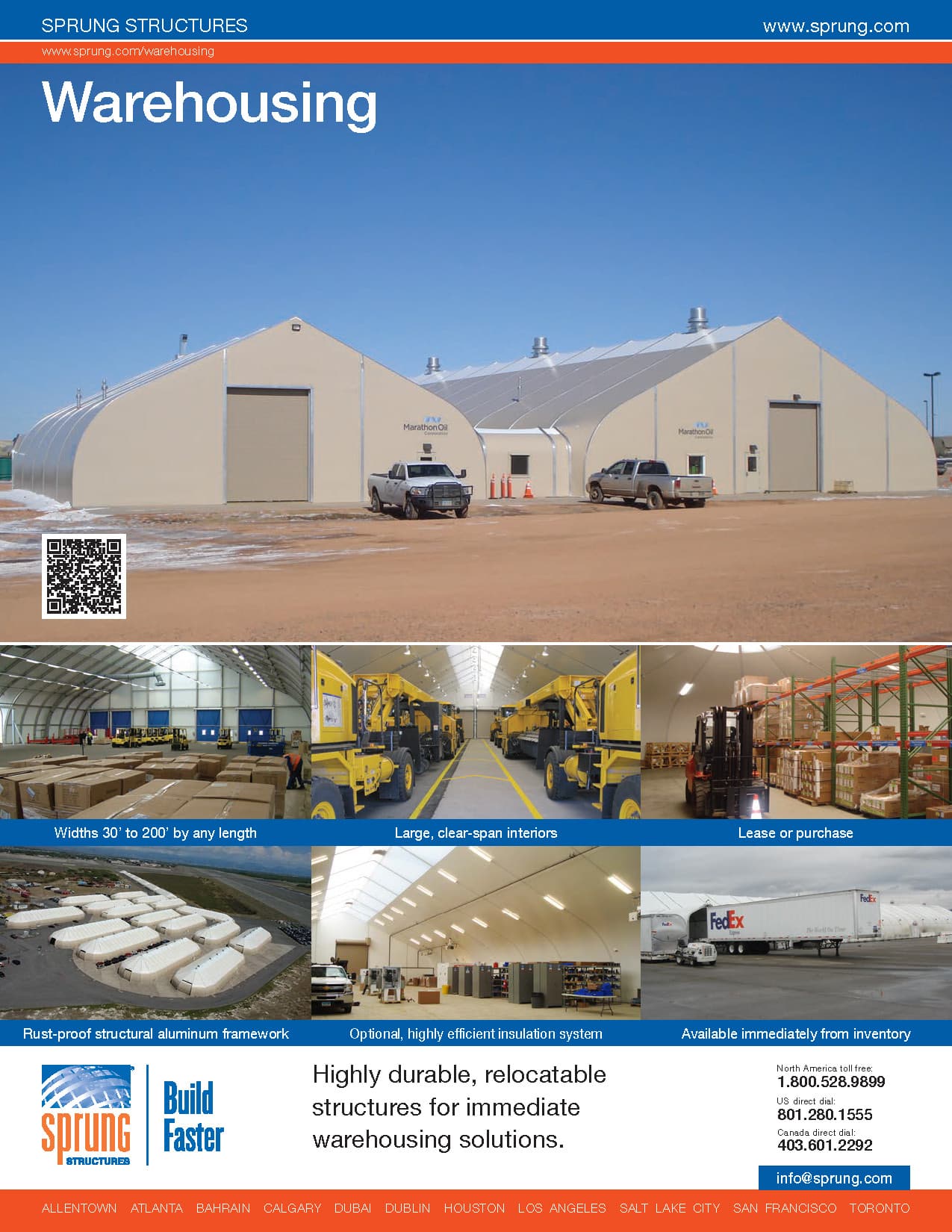
Sprung’s warehouse structures offer a practical solution for organizations needing permanent or temporary storage facilities built quickly. Supporting everything from distribution and cargo handling to long-term storage, our warehouse buildings are used across a wide range of industries. Whether you’re looking for a portable warehouse, a series of cold storage structures or a highly customized warehousing solution, Sprung helps businesses expand storage capacity efficiently, without the delays typically associated with conventional construction.
Speed of Construction
Designed for rapid deployment, a Sprung warehouse structure helps reduce construction timelines and improve project flow. With a prefabricated building system and available inventory, these permanent and temporary storage structures can be delivered and installed much faster than traditional warehouse buildings. This speed allows organizations to respond quickly to shifting storage demands, seasonal peaks or supply chain pressures. It also means new temporary storage facilities can be online in weeks rather than the months a conventional warehouse build often takes.
Clear-Span Interiors & Flexible Layouts
The clear-span design of a Sprung warehouse building creates a highly adaptable interior with no columns to work around. This makes it easier for organizations to implement efficient layouts that can accommodate everything from shelving and racking areas to cargo handling and processing zones. As operational needs shift, interior configurations can be adjusted without structural constraints, offering the optimal level of flexibility for both permanent and temporary storage buildings.
Portable Warehouse Design
Sprung’s permanent and temporary storage structures are engineered for long-term durability and repeated use in a variety of environments. The structural aluminum framework is corrosion-resistant, while the tensioned membrane system performs reliably over time. When needs change, these warehousing structures can be disassembled, relocated and reinstalled, supporting both temporary warehouse needs and long-term operational flexibility. For temperature-sensitive inventory, the same buildings can be insulated and outfitted as cold storage structures, while lighter temporary storage shelters suit seasonal or short-term overflow.
FAQs About Fabric Warehouse Buildings
When are fabric warehouses better than permanent warehouse construction?
A fabric warehouse building is often a better option when speed, flexibility or future expansion are important considerations. A fabric warehouse structure can be installed more quickly than a conventional warehouse building and has minimal foundation requirements. Sprung warehouses can serve as permanent or temporary storage buildings while retaining the ability to be expanded or relocated as operational needs change. The flexibility of Sprung portable warehouse is particularly valuable in fast-growing or evolving distribution environments.
How do fabric warehouses perform under heavy snow and wind loads?
Fabric warehouses perform well under heavy snow and wind loads, thanks to their specifically engineered building components. The tensioned membrane and structural framework of a fabric warehouse building work together to distribute snow and wind loads efficiently across the structure, helping maintain structural stability during severe weather events. Sprung warehouses are engineered to meet local building code requirements for snow, wind and seismic loads, with designs customized for regional conditions. This allows Sprung’s permanent and temporary storage facilities to operate reliably in challenging climates.
How do fabric warehouses support high-volume storage and distribution?
A fabric warehouse structure supports high-volume storage and distribution by providing open, unobstructed interior space for inventory, equipment and material handling. The clear-span layout of a fabric warehouse building allows operators to maximize shelving and racking configurations while maintaining efficient traffic flow for forklifts, loading equipment and more. Sprung’s permanent and temporary storage buildings can be configured to support receiving, storage, picking, packing and shipping operations within a single facility. This helps streamline workflows and improve overall warehouse efficiency.
How can fabric warehouses expand capacity without shutting down operations?
A fabric warehouse building can be expanded by extending the structure’s footprint lengthwise or by adding connected fabric structures that can further support storage, fulfillment or distribution activities. Because new sections can be added with limited impact on the existing warehouse structure, operations can typically continue throughout the expansion process. Sprung’s permanent and temporary storage shelters are designed to accommodate phased growth through modular additions and connected structures. This approach minimizes operational disruption while allowing capacity to increase over time.
How do fabric warehouses handle loading docks and truck access?
A fabric warehouse structure can accommodate loading docks and truck access by integrating overhead, rolling or sliding door systems into the building design. Dock-high loading bays, grade-level access points and oversized vehicle openings can all be incorporated in a clear-span warehouse to support receiving, shipping and cross-docking operations. Sprung’s permanent and temporary storage buildings feature unobstructed space around loading areas, allowing trucks, forklifts and material-handling equipment to move efficiently throughout the facility. This supports smooth product flow from receiving through distribution.
How do fabric warehouses manage condensation and humidity control?
A fabric warehouse structure manages condensation and humidity by controlling temperature differences, air movement and moisture levels within the building. Condensation typically occurs when warm, moisture-laden air comes into contact with cooler surfaces, making insulation and air sealing important considerations. A Sprung clear-span warehouse can incorporate a high-performance insulation package and HVAC system within a virtually airtight building envelope to reduce heat transfer and limit uncontrolled air infiltration. This helps maintain stable interior conditions and reduce the risk of moisture buildup.
How do fabric warehouses support mezzanines, offices and pick areas?
Fabric warehouse buildings support mezzanines, offices and pick areas by providing large, clear-span interiors that can be customized around warehouse workflows. Because the clear-span design of a Sprung warehouse building eliminates interior columns, freestanding mezzanines and office areas can be positioned where they best support storage, administration and inventory management functions. The open floor plan of a clear-span warehouse also makes it easier to establish dedicated picking, packing, staging and shipping areas while maintaining efficient circulation for personnel and operational equipment.
What foundation choices work for rapid warehouse deployment?
Rapid warehouse deployment often relies on building systems that minimize site preparation and foundation requirements. Because a fabric warehouse structure is significantly lighter than most conventional warehouse buildings, less concrete and excavation are typically required to support the facility. A permanent or temporary warehouse designed by Sprung can be installed using simplified foundation systems, earth anchors or even existing paved surfaces. This flexibility helps accelerate construction timelines and allows facilities to be deployed on sites that may not be practical for traditional warehouse construction.