









About Sprung’s Ice Arena Buildings
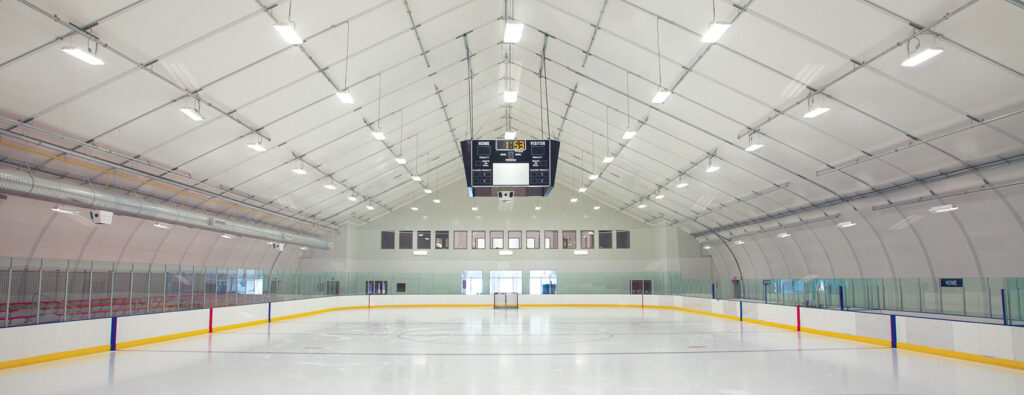
Sprung’s arena buildings provide fast, flexible space for indoor ice rinks and community skating facilities. Municipalities, school districts, stadium builders and private operators use Sprung’s arena structures for recreational skating, hockey and other sporting events. Through innovative design and engineering, these arena structures can be erected quickly, with minimal foundation requirements, and offer a better return on investment thanks to their lower construction and operating costs.
Ice Quality & Climate Control in a Sprung Arena Building
A Sprung arena center or stadium building comes with an energy-efficient insulation package that ensures climate controllability and helps lower overall operating costs. Sprung’s arena structures are also designed to accommodate refrigeration systems, specialized HVAC equipment and other operational components that help regulate temperature, airflow and humidity. This environmental control supports stable ice conditions within the arena enclosure while improving comfort for skaters, spectators and staff.
Sprung’s Arena Structure Amenities
Thanks to its clear-span design, a Sprung arena building can accommodate a wide range of amenities beyond exceptional ice surface. Interior layouts can include areas for locker rooms, equipment storage, rental facilities, concessions, washrooms and spectator seating. The unobstructed interior space gives the stadium builder freedom to design functional areas and circulation paths around the rink.
Arena Enclosure Maintenance & Expansion Readiness
Sprung’s arena structures require very little maintenance due to their structural aluminum framework and high-performance architectural membrane, which eliminate the need for painting, rust protection or roof replacement. The modular structure of a Sprung arena center also allows operators and stadium builders to easily expand, reconfigure or add amenity spaces as their programming needs change or grow. This adaptability helps support phased development and long-term planning.
FAQs About Sprung Arena Structures
Can fabric buildings be used to house indoor ice arenas?
Yes, fabric buildings can be used to house indoor ice arenas if they are designed to accommodate refrigeration, HVAC and insulation systems. Sprung’s arena structures are engineered to support the operational and mechanical elements needed to maintain an interior ice surface. These high-performance arena enclosures are also built to withstand challenging external weather conditions.
How does a fabric arena building perform as year-round community ice arena?
A fabric arena enclosure performs well as a year-round ice facility when equipped with appropriate mechanical and environmental systems. Insulation packages, refrigeration equipment and HVAC systems work together to maintain stable interior temperatures within a fabric arena structure. A Sprung arena building accommodates these elements in order to support continuous operation for community skating, hockey and training programs, no matter the season.
How can modular arenas add seating, training spaces and other amenities?
Seating, training spaces and other amenities can be incorporated into modular arena enclosures with ease, thanks to the buildings’ unobstructed interiors. A Sprung arena structure or stadium building is also designed to expand lengthwise, which means that additional facilities and conveniences, such as locker rooms or concessions, can be added later as programs expand. Sprung arena structures support additions without requiring major structural changes.
How do fabric arenas support multi-sport use beyond hockey?
Fabric arenas support multi-sport use by providing large, unobstructed interior spaces that can be adapted for different activities. A Sprung arena building is often used for both on-ice and off-ice programming within the same enclosure. Ice surfaces within a Sprung arena enclosure can be used for activities such as hockey, ringette and figure skating, but these ice surfaces can also be covered or removed to accommodate dry-floor sports such as lacrosse, basketball or indoor soccer. The flexibility of Sprung’s arena structures allows them to serve broader community recreation needs.
How fast can a covered ice rink be built with modular structures?
Covered ice rinks built with modular structures can be completed much faster than conventional arenas thanks to their simplified design and construction processes. Sprung arena buildings have minimal foundation requirements, and the building design phase typically takes days rather than months. Once on-site, construction progresses quickly, with installation rates ranging from approximately 1,000 to 2,400 square feet per day, depending on options and site conditions.
Are fabric structures suitable for northern or remote communities?
Yes, fabric arena structures are suitable for northern or remote communities because they require minimal foundations and rely on prefabricated components. Much of a Sprung arena building is manufactured off-site, which reduces on-site labor and construction time in locations with short building seasons. Sprung arena enclosures are also engineered to handle snow loads, wind conditions and cold climates, ensuring reliable performance in challenging environments.
How do fabric arenas control humidity and ice surface quality?
A fabric arena building controls humidity and ice quality by combining various mechanical systems with a virtually airtight building envelope. The high-performance membrane on a Sprung arena enclosure limits uncontrolled air infiltration, which helps stabilize temperature and humidity levels inside the arena. HVAC, refrigeration and dehumidification systems then regulate airflow and moisture above the ice surface to reduce condensation. This controlled environment supports consistent ice quality.
How do modular arenas compare to traditional steel or brick rinks?
Modular arena structures offer faster construction timelines and greater flexibility compared to traditional steel or brick rinks. They support similar mechanical systems for ice making, climate control and year-round use, while allowing for future expansion or relocation. Choosing a Sprung arena building reduces construction complexity and long-term inflexibility, making it a practical option for communities and stadium builders who want an arena center that delivers performance, speed and adaptability.