









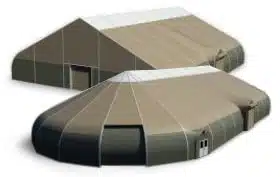
About Sprung’s Oil and Gas Buildings
Sprung’s oil and gas structures are highly durable building solutions for energy-related operations in any environment. The prefabricated system of a Sprung structure allows for rapid design, delivery and installation, with minimal foundation requirements and reduced construction timelines compared to conventional oil and gas buildings. Sprung structures can be used for maintenance facilities, warehousing, natural gas storage buildings, office space, workforce housing, lunch tents and more.
Modular Expansion & Relocatability
An oil and gas industry structure by Sprung can be expanded, reconfigured or relocated as project requirements evolve. Thanks to their modular design, our oil and gas buildings, including natural gas storage facilities, can be lengthened, reduced, dismantled and reinstalled at new sites, supporting both temporary and long-term operations. Plus, minimal foundation requirements help simplify relocation and reduce site disruption in remote or environmentally sensitive areas. A Sprung structure can scale from a workforce lunch tent or natural gas storage building to a full oil and gas industry structure as project needs evolve.
Oil and Gas Building Design
Sprung’s oil and gas structures feature a clear-span design that offers unobstructed space for equipment, vehicles, workers and more. The absence of interior columns allows our oil and gas buildings to be configured or adjusted without structural interference, which means layouts can be easily adapted for a variety of industry needs, including maintenance bays, drilling support, natural gas storage facilities or multi-faceted operations. This flexible design supports evolving project requirements over time.
Durability & Performance
Sprung oil and gas buildings are engineered to perform in challenging environmental conditions, including extreme temperatures, high winds and intense storms. The virtually airtight membrane and high-performance insulation options that come with each oil and gas industry structure help maintain stable interior conditions, while our corrosion-resistant structural aluminum reduces maintenance requirements over time. These features support reliable operation and long-term durability no matter the location or application.
FAQs About Sprung Oil and Gas Buildings
Which design features help fabric oil and gas buildings handle harsh weather?
There are a variety of design features that ensure fabric oil and gas structures, including natural gas storage facilities, will perform well in harsh weather. A sealed building envelope, combined with high-performance insulation and easily integrated HVAC, help to maintain a stable interior environment, no matter the conditions outside. Sprung oil and gas buildings use corrosion-resistant materials and tensioned membranes to limit air infiltration, reduce exposure to moisture and easily shed snow. These features support continuous operation in remote and extreme environments.
How do clear-span interiors improve equipment servicing and workflow?
Clear-span interiors improve equipment servicing by eliminating interior columns that can restrict movement and access. This allows large vehicles, skids and maintenance equipment to be positioned and serviced more efficiently within a single open workspace. An oil and gas industry structure with a clear-span interior helps crews move equipment more efficiently and maintain safer workflows without structural interference. Sprung oil and gas buildings offer layout flexibility that helps streamline daily field activities.
How do fabric buildings support oilfield maintenance and staging operations?
Fabric oil and gas buildings support oilfield maintenance and staging by providing enclosed, clear-span spaces where equipment and vehicles can be protected without structural obstructions. This improves workflow by making it easy for maintenance crews to service rigs, trucks and skids in a single space. Compared to conventional construction, fabric oil and gas structures are deployed faster, with minimal foundation requirements, ensuring that maintenance facilities can be established closer to active operations. Sprung oil and gas buildings reduce downtime, improve access to equipment and support more efficient staging in the field.
What foundation options work best for remote oil and gas sites?
Remote oil and gas sites tend to use simplified foundation systems in order to reduce excavation and material requirements. This allows construction to proceed more quickly in areas with limited access, unstable ground or short build seasons. Minimal foundation requirements also make it easier to install or relocate an oil and gas industry structure as site conditions change. Sprung oil and gas buildings are designed to work with minimal foundation requirements, allowing installation with reduced site preparation. This simplifies deployment in remote or logistically challenging areas.
When are relocatable structures better than permanent oilfield buildings?
Relocatable oil and gas structures are better suited for oilfield projects in which site requirements, production levels or timelines change over the life of the operation. These buildings can be installed quickly and serve as long-term facilities while still offering the ability to be dismantled, transported and redeployed to new locations. Sprung’s relocatable oil and gas buildings support both temporary and long-term use while avoiding the constraints of fixed construction. This allows operators to align infrastructure with shifting project demands.
What door configurations in fabric oil and gas structures work for oversized oilfield vehicles and skids?
Fabric oil and gas buildings can be designed to accommodate oversized vehicles, skids and equipment. Door systems such as sliding, rolling and bi-fold configurations can be easily integrated into an oil and gas industry structure to meet a project’s specific operational needs. Sprung oil and gas buildings support wide openings and flexible door configurations without interior obstructions. This allows equipment to move in and out of the structure efficiently.
How do insulated fabric buildings perform in extreme cold regions?
Insulated fabric oil and gas buildings perform effectively in extreme cold by reducing heat loss and maintaining consistent interior temperatures through layered insulation and sealed building envelopes. This helps prevent condensation, protect equipment and improve working conditions for personnel. Used in cold-weather regions where consistent indoor environments are critical for operations, Sprung’s insulated oil and gas structures, including natural gas storage buildings, support HVAC systems that distribute heat evenly across large interior spaces, ensuring year-round functionality.
How can modular buildings expand as oil and gas operations grow?
Modular buildings, which can be used for everything from lunch tents to natural gas storage facilities, are expanded by adding additional sections or extending the length of the structure as an operation’s demands increase. This allows facilities to scale alongside production levels, workforce size or equipment requirements. Sprung oil and gas buildings are designed so new sections can be integrated without disrupting existing operations. This supports phased development and long-term flexibility.